Team leader: Dr Maryam Ghodrat
National Capability in Battery Safety, Extreme‑Climate Resilience, and Risk Modelling
The Advanced Battery Safety Research Team (ABS) at UNSW Canberra is a national hub for next‑generation battery safety, thermal‑risk science, and resilient energy‑storage engineering.
The laboratory integrates advanced diagnostics, pyrometric testing, extreme‑climate stress evaluation, and AI‑enabled modelling to address the urgent challenges associated with modern electrochemical energy systems. ABS supports Australia’s transition to safe, reliable, and high‑performance energy technologies by delivering world‑class research, standards‑aligned testing, and industry‑ready solutions.
Mission
Advanced Battery Safety Research Team (ABS) advances the science and engineering of battery safety across the full lifecycle, from materials and cell behaviour to pack‑level performance and system‑level risk. The laboratory’s mission is to:
- Develop safer, more resilient energy‑storage systems for critical applications.
- Provide rigorous, standards‑aligned testing and diagnostics for emerging battery chemistries.
- Build predictive, AI‑enabled models for thermal runaway, degradation, and failure modes.
- Support industry, government, and defence partners with evidence‑based safety insights.
- Train the next generation of engineers and researchers in advanced battery science.
- Strengthen national resilience by modelling climate‑driven risks, including flood‑damage estimation for power grids and distributed energy systems.
Research Themes
Battery Safety and Abuse Testing
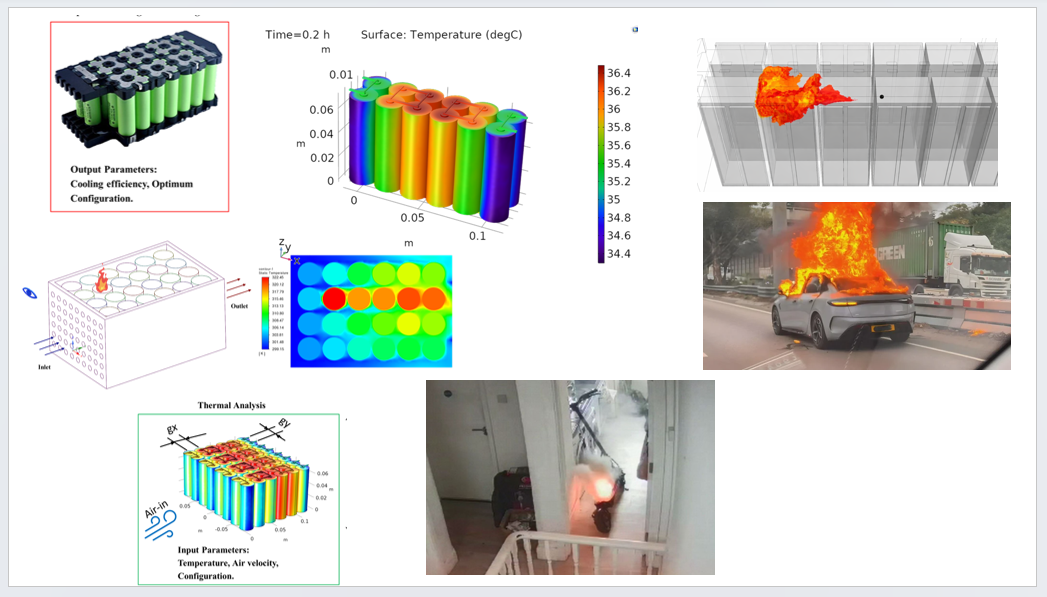
ABS conducts controlled thermal, mechanical, and electrical abuse testing to characterise failure mechanisms and quantify safety margins. The laboratory’s pyrometric capabilities enable high‑fidelity measurement of heat release, ignition behaviour, and propagation dynamics.
Thermal Management and Fire Science
The team investigates heat generation, dissipation, and runaway behaviour across cell and pack configurations. Research includes advanced thermal modelling, fire‑resilient design strategies, and the development of mitigation technologies for high‑risk environments.
AI‑Enabled Diagnostics and Predictive Modelling
Machine‑learning and physics‑informed models are used to predict degradation, detect early‑stage faults, and simulate extreme‑condition behaviour. These tools support real‑time monitoring, digital twins, and intelligent battery‑management systems.
Next‑Generation Energy‑Storage Systems
ABS evaluates emerging chemistries, including solid‑state, sodium‑ion, and high‑temperature systems, to assess safety, performance, and suitability for defence, aerospace, grid, and mobility applications.
Climate‑Driven Infrastructure Risk Modelling
ABS develops models for the estimation of flood damage to power grids, integrating:
- Hydrological hazard modelling.
- Substation and ESS vulnerability mapping.
- Failure‑probability estimation for distributed storage assets.
- Coupled thermal‑electrical‑environmental risk frameworks.
- This work supports utilities, defence, and emergency‑management agencies in planning resilient energy systems.
Facilities and Capabilities
- Pyrometric testing infrastructure for high‑temperature and combustion‑related measurements.
- Thermal runaway chambers and controlled abuse‑testing platforms.
- High‑speed imaging and advanced sensor instrumentation.
- AI‑enabled modelling and simulation environment.
- Integrated data‑acquisition and analysis systems.
- Collaboration access to UNSW Canberra’s wind tunnel, sand burner, and advanced materials laboratories.
Partnerships and Impact
ABS team works closely with industry, defence, government agencies, and research organisations to deliver practical, standards‑aligned solutions. The laboratory contributes to national capability in:
- Battery safety certification and compliance.
- Fire‑resilient energy‑storage design.
- Risk assessment for critical infrastructure.
- Development of sovereign testing and diagnostic technologies.
Education and Training
The team supports HDR students, early‑career researchers, and professional engineers through:
- Research supervision and mentoring.
- Hands‑on training in advanced testing and modelling.
- Short courses and workshops on battery safety and energy‑storage engineering.
Recent Publications
- Ali MMEH; Tahtali M; Ghodrat M, 2026, 'Spatiotemporal dynamics for fire type detection: Differentiating lithium-ion battery, benign, and conventional fires', Fire Safety Journal, 162, http://dx.doi.org/10.1016/j.firesaf.2026.104789,
- Ali MMEH; Tahtali M; Ghodrat M, 2025, 'Real-time CCTV-based deep learning for early detection of lithium-ion battery fires', Journal of Power Sources, 659, http://dx.doi.org/10.1016/j.jpowsour.2025.238452
- Ncube R; Ghodrat M; Escobedo-Diaz JP, 2025, 'From frameworks to firewalls: metal-organic frameworks as smart additives for flame-retardant polymers', Polymer Degradation and Stability, 242, http://dx.doi.org/10.1016/j.polymdegradstab.2025.111643
- Ali MMEH; Ghodrat M; Wang W, 2025, 'Advancing thermal runaway modeling in lithium-ion batteries: A review of heat source models, thermodynamic frameworks, and microkinetic approaches', Journal of Energy Storage, 132, http://dx.doi.org/10.1016/j.est.2025.117762
- Li A; Abpeikar S; Wang M; Frankcombe T; Ghodrat M, 2025, 'An integration framework based on deep learning and CFD for early detection of lithium-ion battery thermal runaway', Applied Thermal Engineering, 274, http://dx.doi.org/10.1016/j.applthermaleng.2025.126460
- Ali MMEH; Ghodrat M, 2025, 'Thermal and combustion characteristics of vent gases from lithium-ion battery thermal runaway: a comprehensive review', Journal of Thermal Analysis and Calorimetry, 150, pp. 13925 - 13952, http://dx.doi.org/10.1007/s10973-025-14616-8,
- Ali MMEH; Ghodrat M, 2025, 'Reliable Indoor Fire Detection Using Attention-Based 3D CNNs: A Fire Safety Engineering Perspective', Fire, 8, http://dx.doi.org/10.3390/fire8070285,
- Ali MMEH; Ghodrat M; Gad M, 2024, 'Numerical Investigation of Thermal Runaway and Fire Characteristics in Large-Format Lithium-ion Batteries.', in Proceedings of the 24th Australasian Fluid Mechanics Conference (AFMC), Canberra, Australia, presented at 4th Australasian Fluid Mechanics Conference (AFMC), Canberra, Australia, 01 December 2024 - 05 December 2024, http://dx.doi.org/10.5281/zenodo.14213344,
- Ncube R; Ghodrat M; Escobedo-Diaz JP, 2025, 'From frameworks to firewalls: metal-organic frameworks as smart additives for flame-retardant polymers', Polymer Degradation and Stability, 242, http://dx.doi.org/10.1016/j.polymdegradstab.2025.111643
- Nabuai J; Escobedo-Diaz JP; Zinoviev A; Ghodrat M, 2026, 'Multi-scale Flame Retardancy in Aerospace Carbon Fibre Reinforced Polymers (CFRPs) Using Hybrid Fibres and Graphene Oxide (GO)', in , pp. 103 - 112, http://dx.doi.org/10.1007/978-3-032-13600-8_10
Research Team:
Dr Maryam Ghodrat (Team lead)
Research Associates:
Dr Ali Edalati-nejad
Osman Eissa
Randy Ncube
Dr Mohamed Mohamed
Dr Ao Li
PhD students :
Mostafa Ali (PhD student)
Mohamed Hamed (PhD student)
Honour theses
Markus Zarak
Angus Biggs